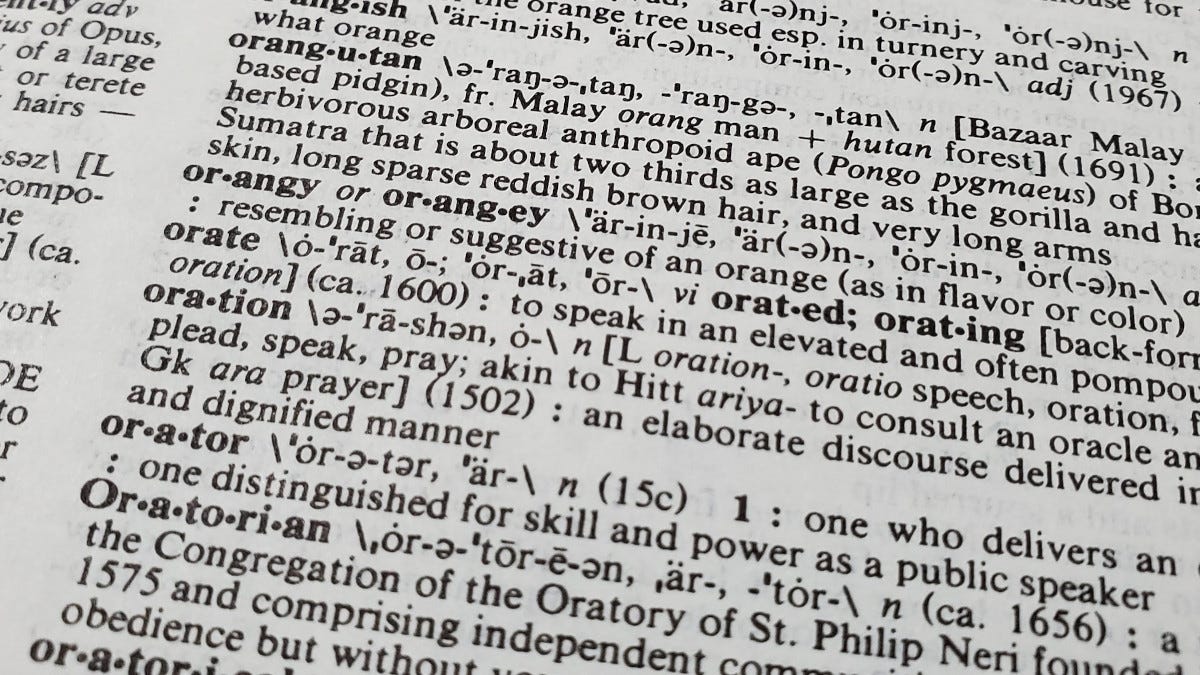
Of all the forms of educational technology that have ever been introduced, from the pencil to the chalkboard to the personal computer, perhaps the most elegant is the humble desktop dictionary. Think of its many magnificent features.
■ The dictionary is effectively self-contained: Starting from the knowledge of only a few basic words, a child can construct the meanings of all other words by building from one entry to another.
■ It manages to be comprehensive and yet compact at the same time. And from the knowledge contained in a dictionary, effectively all other learning can be developed with enough access to the right books. Imagine what historians would give just to have a thorough dictionary of certain dead and lost languages.
■ A good dictionary manages to avoid circular references while introducing background information of great value, like word origins, historical uses, and designated correct pronunciations.
■ The only real flaw to the dictionary is the inescapable fact that a person can't look for a word with certainty without knowing how it is spelled, though the navigational clues within the dictionary can help.
■ The other thing the dictionary offers is serendipity. Words being listed alphabetically don't necessarily have anything to do with one another, but an adjacent word to the one the reader is searching may, in fact, open up a brand-new door to something entirely worth knowing. That may not always be the case, but there is a certain joy to be found in encountering something new and satisfying.
■ Tools like dictionaries are indispensable, even when they seem to be out of favor. We shouldn't assume that schoolkids are learning how to use the paper dictionary, when spell check and online dictionaries are readily available on their school-issued tablets and laptops.
■ But the habits and practices of their use need to be handed down, especially when companies as reputable as Microsoft are turning over their grammar checks to artificial intelligence while others, like Grammarly, are touting their tools to take over writing altogether. We are sailing mostly unwittingly into dangerous waters, and history is witness that enough other arts have been lost to time. Save the language and make a child look up what Webster's has to say.