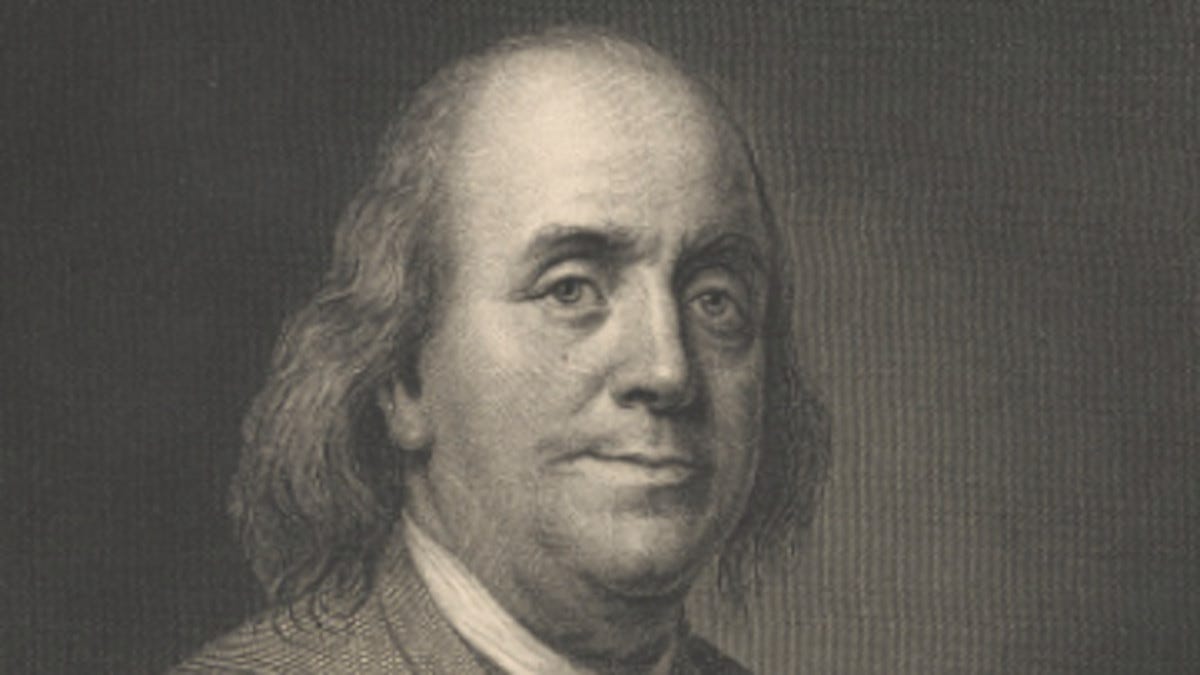
Benjamin Franklin left behind hundreds of proverbs. Many are good advice, but some have aged so well that they’re even more appropriate now than they could have been when written. One of those: “They who have nothing to trouble them, will be troubled at nothing.”
■ Since Franklin’s time, we have overcome unbelievable troubles: Smallpox is gone. Drinking water is safe. Roads are paved. Electricity flows nearly everywhere. Refrigeration keeps food from spoiling. Antibiotics kill infections. And on and on.
■ Many of these troubles were especially consequential for young people, who often faced real toil on top of their hardships. Franklin himself only had two years of formal schooling before entering a work apprenticeship at age 12 (in which he became an indentured servant to his own brother for a nine-year contract). By age 17, he had run away from “home” and his brother’s control.
■ Today, schooling is compulsory until at least age 16 everywhere in the United States, indentured servitude is forbidden, and an array of rules controls when juveniles can work (no earlier than 14, and heavily restricted through at least age 16). Parents who neglect the needs of their children can be punished as criminals.
■ All of these are improvements and advancements over the status quo ante. In no way, shape, or form should we look to roll back the abundant progress that has been made. But if it seems like people express ever-greater division over ever-smaller real differences, it might just be that we are being “troubled at nothing”.
■ And in eliminating many of the involuntary problems of life from the past, we create a paradox: The ability to solve big problems usually depends upon exposure to smaller ones. We learn to recognize patterns in those problems we face, making us better at solving the new ones. So, unless we actively create artificial problems for young people to solve, they end up lacking some of the very experiences necessary for solving the bigger problems of adulthood -- and the problems remaining to be solved are by definition more complex than the ones that have already been settled.
■ Those artificial problems don’t have to be big or painful, but they have to exist somehow, even if it’s within artificial contexts and constructed environments. We can’t just pour knowledge into juvenile minds and hope for the best. We have to send them on Scouting campouts and make them change tires that aren’t flat and challenge them to navigate to unfamiliar destinations without the help of GPS. Artificial problems encountered with a generous safety net still beat arriving in adulthood with no base for contextualizing the real problems we cannot avoid.
■ The knowledge of the world may be at our fingertips like never before, but “knowing about” isn’t the same as “knowing how”. If we really want to secure the benefits of all the progress that got us here, we have to ensure that we impose the structures that will equip younger generations to use that progress well.