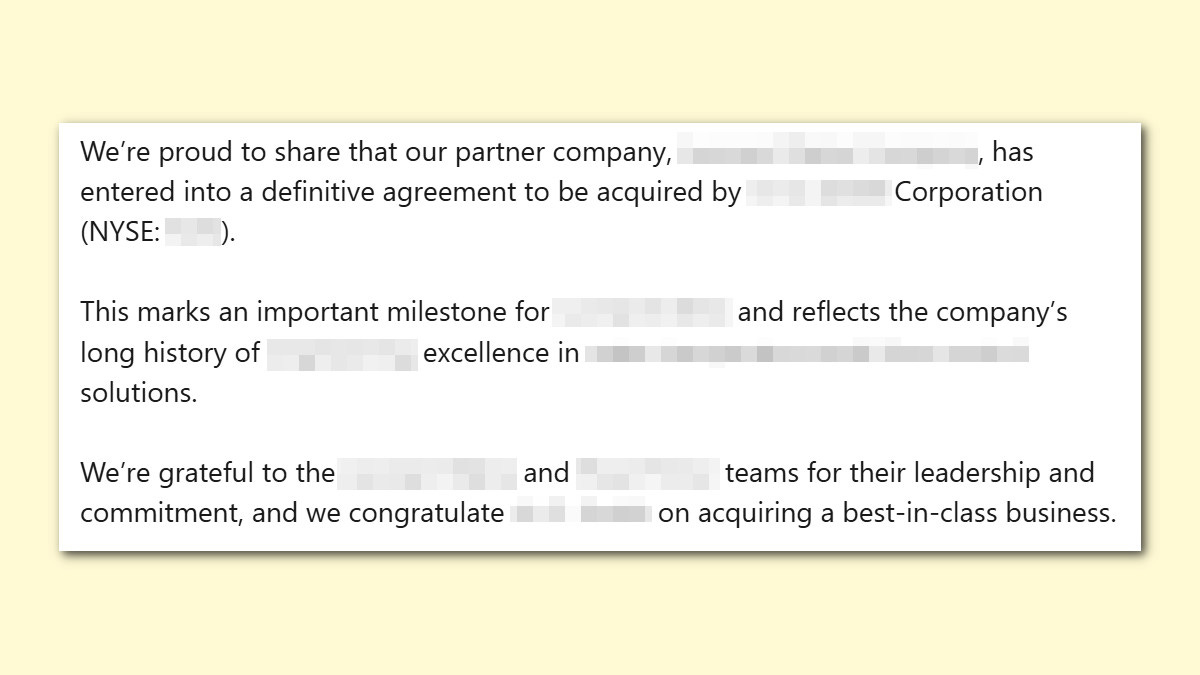
It’s a strange thing to publicly celebrate the termination of a relationship. Even if there were irreconcilable differences and insurmountable incompatibilities to a pairing, it’s still a bit peculiar to see that some people make a living selling whimsical divorce-themed greeting cards. Similarly, it’s odd to see how proudly private equity companies announce the sale of the companies they own.
■ The proudly-worded “exit announcement” is a way of saying “We’ve squeezed what we can from this investment; now we’re out!”. It’s also a way of subtly saying that they’ve discovered the classic “greater fool“ willing to pay a premium price. After all, any rational theory of business holds that an owner should retain that ownership so long as the firm appears to be a going concern with prospects for future returns that exceed the price that a buyer might be willing to pay.
■ Obviously, it doesn’t always work out that way; sometimes, a sale is merely an announcement of a reluctant inevitability, as when known newspaper enthusiast Warren Buffett sold his company’s newspaper operations to Lee Enterprises after seeing an irreversible deterioration in media economics.
■ But that’s the strange thing about private-equity firms: They buy in order to sell. Holding periods are generally in the ballpark of six years -- a single term in the Senate, or about the time it took to build the Channel Tunnel. For all the talk of “partnerships” and “value creation”, the whole principle of the approach is centered on the plan to get out.
■ “Buy and hold” isn’t an approach that appeals to everyone, but it’s hard to find a lot of truly great institutions that passed from one owner to another like a hot potato. And it’s similarly hard to find a lot of great fortunes made by turning businesses like a restaurant wait staff turns tables. Patient, sustainable business ownership has a lot going for it that no “exit announcement” will ever represent.