One of the great sources of wisdom in life is to find two pieces of seemingly equally good advice that are in some sort of conflict with one another. Through this process, the mature mind learns the virtue of appreciating tension -- that life is rarely so much about stark matters of black and white blending into some mushy gray, but rather much more often about seeing that it takes red, green, and blue together to produce white light.
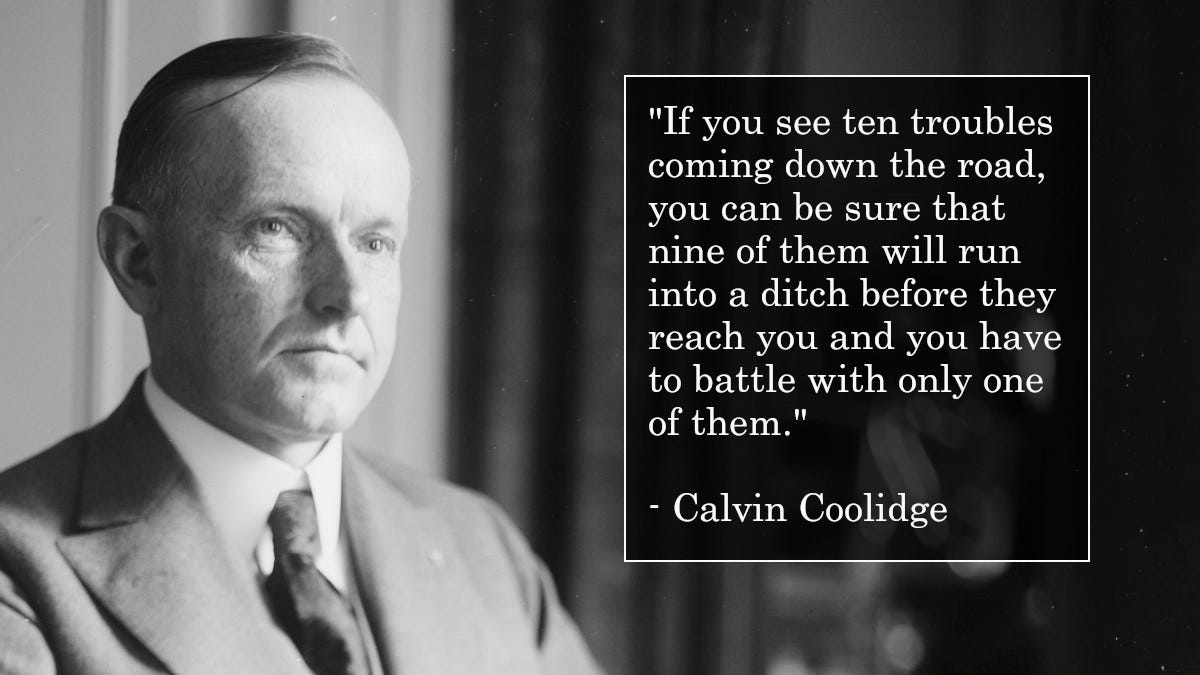
■ A good example: Calvin Coolidge recommended that “If you see ten troubles coming down the road, you can be sure that nine of them will run into a ditch before they reach you and you have to battle with only one of them.”
■ An apparently opposing piece of advice comes from Benjamin Franklin, who said in his 1749 Poor Richard’s Almanack, “What can be done, with Care perform to Day, Dangers unthought-of will attend Delay”.
■ Yet it only appears at first glance that these two aphorisms are in conflict. In fact, they are merely in tension: Coolidge’s advice appears to suggests doing nothing and obeying inertia, while Franklin’s advice seems to suggest a frenetic pace of activity. The tension that binds them is the recognition that time is fleeting -- it is the non-renewable resource that constrains us all.
■ Coolidge’s wisdom holds that we shouldn’t waste it on frivolous concerns, while Franklin’s insight is that time almost always causes compounding effects, whether for good or ill. Both are right.
■ In the opening days of a Federal government shutdown, we ought to carefully ask which problems are worth solving and which are not. As a society, we seem to have assumed that far more than nine out of ten problems can simply be ignored, while also ignoring the perils of Franklin’s “dangers unthought-of” making big problems even bigger.