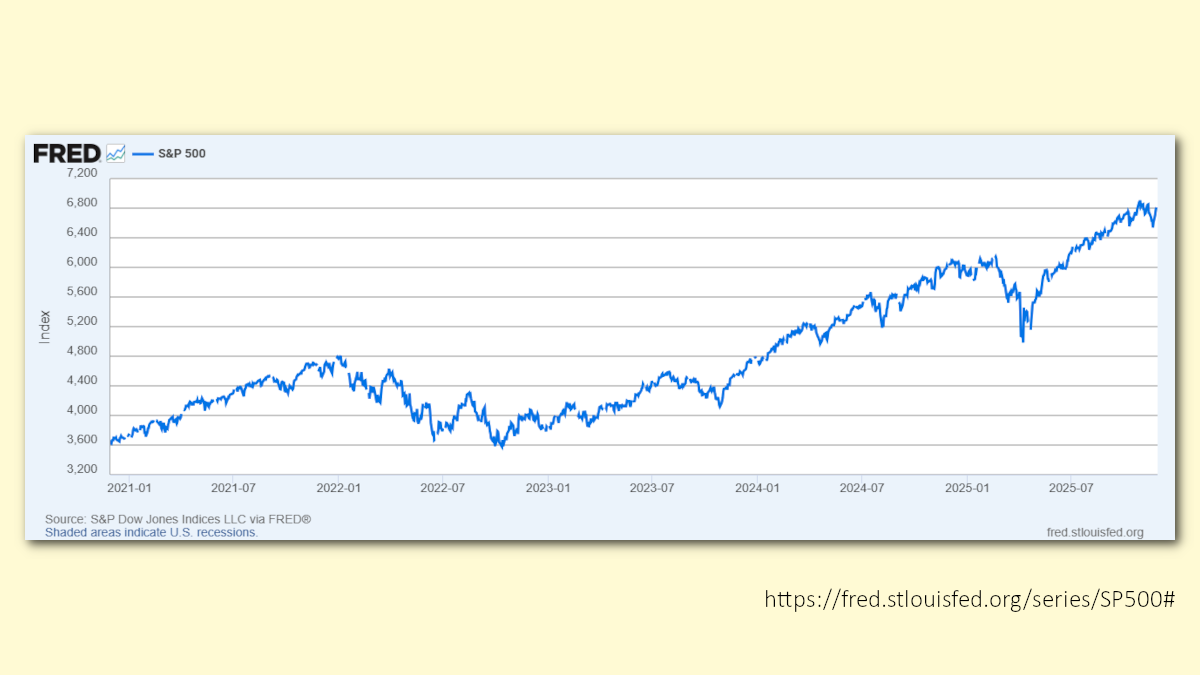
Stock-market index funds are widely used for retirement savings, and for good reason: Their passive approach to investing, coupled with relatively low administrative costs, insulates them from much of the oversized “take” placed on actively-managed investments. Money managers are very good at assuring themselves a substantial return on investment, even when they can’t guarantee the same for their clients. For a very large share of investors, the best bet is to buy into index funds and reinvest for a very long time.
■ One oddity of index funds, though, is that they are generally weighted by market capitalization. That is, the biggest companies are held in the largest amounts. A titanic index fund like the Fidelity 500 Index Fund or the Vanguard Total Stock Market Index Fund won’t hold equal numbers of shares (or total share value) in each of 500 different companies; they hold the companies with the highest total market value (number of shares times price per share) in the largest amounts.
■ For both of those funds (the two largest index funds, according to MarketWatch), and for many others, more than 20% of their value is being carried in holdings of just four companies: Nvidia, Microsoft, Apple, and Amazon. This should have the economically-minded on something of an alert. Not only is that a lot of weight to be putting on a very small number of companies, it’s a heavy concentration in a field subject to a lot of speculation. Nvidia is huge because it is the hottest domestic name in artificial intelligence.
■ But that industry is almost entirely speculative -- its future is utterly unknowable. And people are paying more than 50 times earnings to get a piece of Nvidia. While it doesn’t mean that the market is wrong about that company’s future, it does mean that a whole lot of things must go right in order for the price to be justified.
■ For perspective: 25 years ago, General Electric (then the definitive diversified industrial conglomerate) was the biggest holding in Vanguard’s S&P 500 index fund, representing 4.5% of assets. The top four holdings in the year 2000 crossed three industrial sectors and made up less than 13% of the total fund -- meaning that the index (and the fund tracking it) were much less susceptible to volatility in just one top company or sector. Things were even more diversified by 2002, after the dot-com tech bubble popped (which was back when tech firms were concentrated more in the Nasdaq than in the wider market).
■ We can and should hope that things turn out for the best and that market fanaticism is ultimately justified by fantastic performance. But history doesn’t care much for hope, and the lots-of-nest-eggs-in-one-basket approach runs the risk of turning out very badly for a great number of Americans.