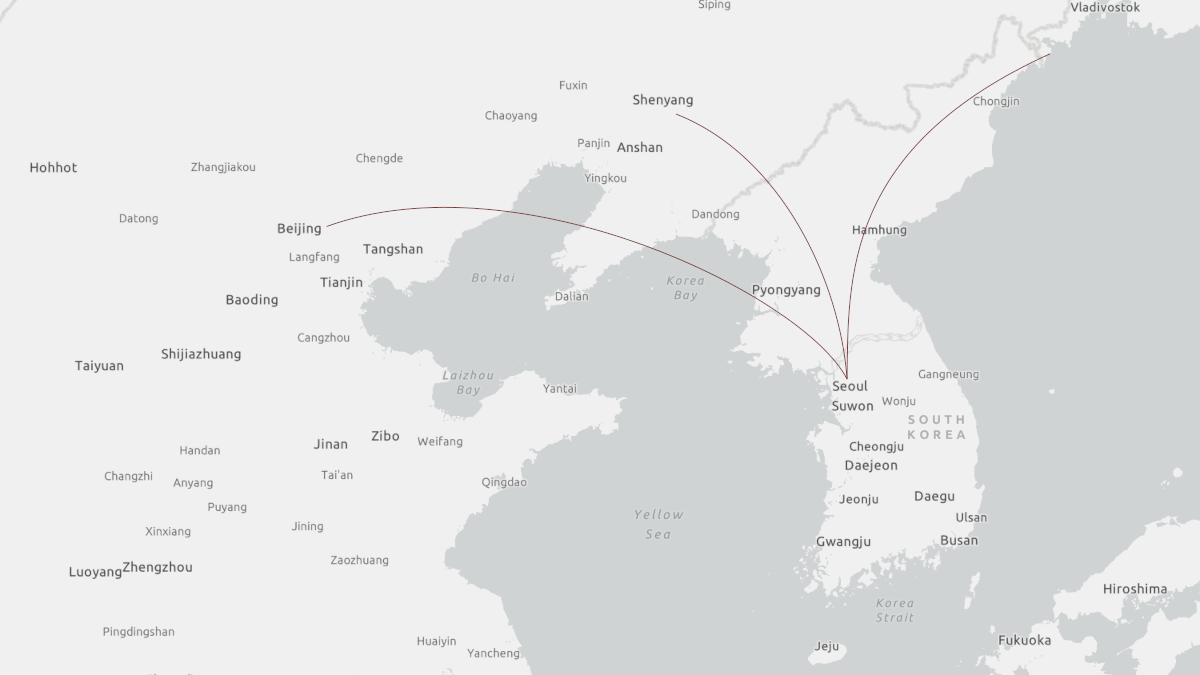
One of the best reasons to become familiar with paper maps is to gain an understanding of scale and relationships that aren’t readily apparent from their digital counterparts. The “Measure Distance” tool on Google Maps can be pretty helpful, and the ability to scroll in and out with nothing more than the spin of a mouse wheel (or the pinch of a touchscreen) can be very handy. But actively engaging with a printed map -- or, better yet, a series of them within an atlas -- opens the door to conceptualization in a way that a right-here-right-now digital map cannot.
■ For example, it’s not necessarily intuitive that Seoul is only 200 to 250 miles from two different sites in mainland China, and only about 400 miles from the nearest part of Russia. Shenyang, a Chinese city of 9 million people, is 350 miles away (as the crow flies), and Beijing is just shy of 600 miles in the distance.
■ These are, in modern terms, very short distances. From New York to Washington, DC, is just a little more than 200 miles. Los Angeles to San Francisco is about 350 miles. Chicago to Fargo is, like Beijing to Seoul, only about a 600-mile hop. All are distances easily crossed by airplanes in times measurable more precisely in minutes than hours.
■ Among many potential nightmare scenarios for our future is this: Driven by irrational motives, North Korea launches an invasion of South Korea. The invasion itself doesn’t have to be successful for China to step in, declaring the region to be within its “sphere of influence”, and asserting dominance over North Korea. China has been propping up North Korea economically for some time, so it’s not unreasonable to imagine a domineering reaction. (All this, of course, involving multiple parties with nuclear weapons.)
■ What stops China from going farther than the DMZ? The deterrent effect of America’s very real and tangible defensive alliance with South Korea. But deterrence depends upon credibility, and that credibility has taken a sudden and serious hit. So serious, in fact, that South Korea’s president promptly reiterated a call for greater domestic control of its defense forces than the country has had since the 1950s.
■ Alliances should never be taken lightly. It’s not cheap to maintain an overseas presence the way the United States does in South Korea, but the cost of prevention should never be examined in isolation. What always matters is the cost (whether potential or likely) of what’s being prevented.