Rep. Jake Auchincloss of Massachusetts confessed in a news story with the outlet “NOTUS” that he’s using artificial intelligence to augment his parenting: “I have three little kids, and I’ll do prompt engineering for a good story. I’m like, ‘I want it to be for a 6-year-old, and I want it to be about helicopters’”. Setting aside that “prompt engineering” is quite the exaggeration for what he describes, there’s something else about the confession that seems misdirected.
■ Parenting can be difficult, exhausting work. As the saying goes, “Long nights, short years.” But parenting is also something that humans have been doing as long as there have been humans. And if there’s one thing that makes our species truly extraordinary, it’s the capacity for complex speech. Speech, in turn, becomes the basis for reading and writing, and the written word unlocks the most powerful way to make ourselves far more intelligent than the limitations of our biological brains. Every book, library, and website becomes accessible, retrievable storage for knowledge that we can borrow without having to remember.
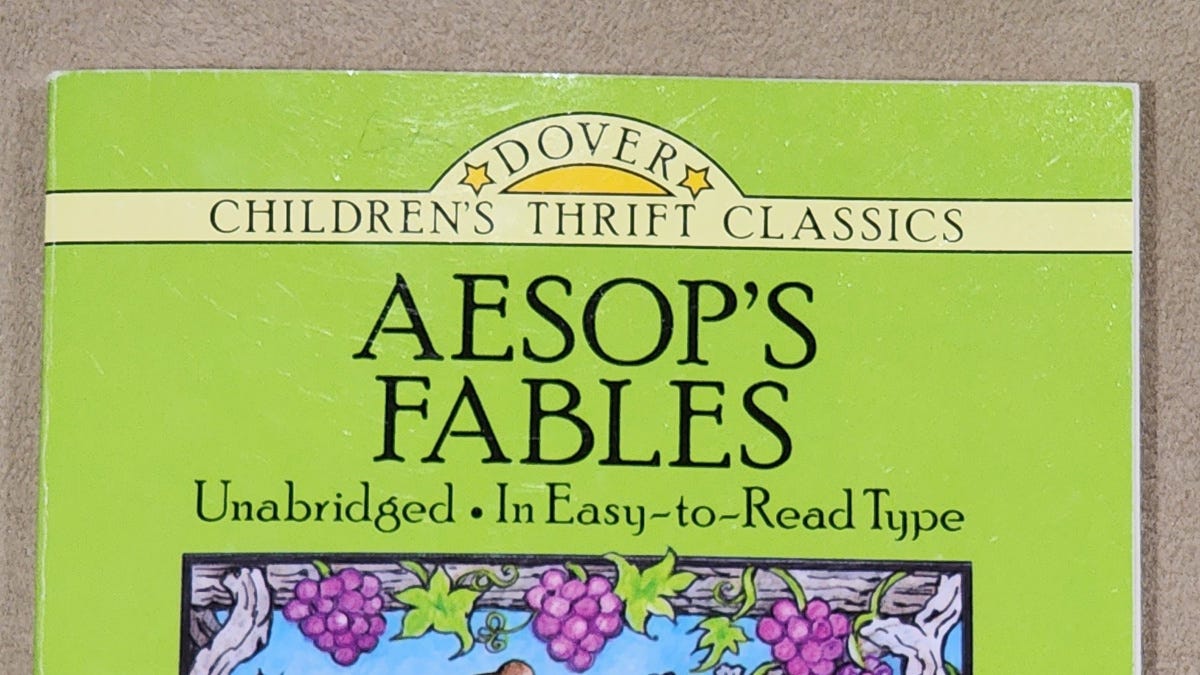
■ Good parenting does involve storytelling -- at bedtime, to teach lessons, or merely to pass the time. And, it turns out, a whole lot of stories have already been written not just to put kids to sleep but to teach them worthwhile lessons: Aesop’s fables, to name just one family of examples.
■ We, as parents, don’t have to make up everything from scratch, nor rely on LLMs to do the imagining for us. Human nature being what it is, stories have always been a part of parenting, so there are innumerable resources containing stories already written down for us. It may sound like cleverness to turn to artificial intelligence to “write” bespoke bedtime stories, but it’s a misapplication of the tools, like trying to drive an Indycar to pick up groceries.
■ Great stories have already been written! Moreover, becoming familiar with some of the canonical stories is an important part of social knowledge -- we need stories, metaphors, and lessons to hold in common. To be able to say something in shorthand like “tortoise and hare” and have it convey real information is a meaningful part of development. Customizable, single-serving bedtime stories might be fine for the occasional change of pace, but the vast library of pre-existing works should routinely get the first look.